Unveiling the Modern Artistic Will of Contemporary Creativity
Contents
Abstract………………………………………………………………………………………….3
- Introduction…………………………………………………………………………………….3
- AI, Artistic Will, and the Creative Dilemma: Exploring the Role of Machine Learning in Art…………………………………………………………………………………………4
- Exploring the Creative Spectrum: Machine Learning, Simulation, and Human-Like Creativity in AI Systems…………………………………………………………………5
- Architectural Alternatives in ML-Based Computational Creative Systems: Exploring the Intersection of Machine Learning and Creativity ……………………………………… 7
- Artistic Boundaries: Benefits of Creativity and Innovation through Machine Learning in Contemporary Art…………………………………………………………………………8
- Conclusion………………………………………………………………………………11
- Reference…………………………………………………………………………………12
Abstract
This essay embarks on an extensive exploration of the enduring impact of Austrian art historian Alois Riegl, particularly through his revolutionary concept of “Kunstwollen” or the will to art. As a pivotal figure in the establishment of art history as an academic discipline, Riegl’s theories persist in shaping the methodologies of present-day art historians. The narrative seamlessly transitions into the contemporary sphere, closely examining the role of advanced technology and artificial intelligence (AI) as potential modern manifestations of artistic will.
The discussion then pivots to the intricate interplay between Riegl’s theories and the realm of AI in contemporary art. It critically evaluates whether AI, with its technological prowess, can be recognized as the contemporary will of art and navigates the intricate challenges of deciphering artistic intent within the domain of AI-driven creativity. While acknowledging AI’s ability to replicate certain artistic styles, the essay asserts that it lacks genuine creativity and a nuanced grasp of cultural context, prompting a reconsideration of its alignment with the intrinsic nature of Kunstwollen.
Delving further, the discourse broadens to encompass the expansive landscape of machine learning, outlining its applications in creative domains. The spotlight falls on generative machine learning models, including Generative Adversarial Networks (GANs) and Variational Autoencoders (VAEs), showcasing their capacity to generate innovative artworks and influence artistic thought. The collaborative synergy between artists and machine learning systems, the automation of repetitive tasks in the artistic process, and the potential for personalized art experiences underscore the transformative influence of machine learning in the creative realm.
The narrative meticulously delineates architectural alternatives within ML-based Computational Creative Systems, elucidating how these systems, propelled by machine learning, engage in the generation and evaluation of creative artifacts. The exploration extends to the advantages of machine learning in contemporary art, revealing its ability to stimulate divergent thinking, automate cumbersome tasks, and contribute to personalized art experiences. Through a synthesis of historical context and cutting-edge technology, this essay navigates the intricate intersections of art, artificial intelligence, and the evolving concept of artistic will, providing a nuanced understanding of their symbiotic relationship in shaping the contemporary artistic landscape.
- Introduction
Austrian art historian Alois Riegl, one of the key figures in the development of art history as a separate academic discipline with his revolutionary thoughts and studies, plays an important role in shaping the approaches of many contemporary art historians to the study of art and its historical context, even today. Alois Riegl’s ideas influenced the fields of Art History and art science, especially the fields of art theory, aesthetics, and the study of artistic periods. Riegl’s perspective on the history of art, his effort to make the discipline more scientific and systematic, his emphasis on formalism, and his theories explaining the importance of historical context to understand the evolution of art are still used today by Michael Baxandall, Erwin Panofsky, Henri Zerner, T.J. Clark has inspired many contemporary art historians and scholars, including Caroline van Eck, Richard Shiff, Joseph Koerner, to explore various aspects of art and visual culture, and his work has left a lasting mark, as evidenced by his ongoing engagement with his various writings.
Riegl’s influence is most notably associated with his pioneering concept of “Kunstwollen,” often translated as “the will to art.” What does that concept mean exactly? Kunstwollen is a concept that underscores the interconnectedness of art and culture, suggesting that artistic creations are not arbitrary but are influenced by the collective spirit and artistic aspirations of a given time and place. This concept underscored the notion that artistic styles and movements are not arbitrary but are deeply rooted in their cultural and historical context. Every period in art history, according to Riegl, possesses a unique artistic will or attitude that shapes the creation of artworks. His emphasis on the historical and cultural context of art has significantly impacted the way we analyze and interpret art. The idea of Kunstwollen suggests that each historical period or culture has its own unique artistic will, which influences the creation of art during that time.
So, in this case, when today’s unique artistic will is discussed, can we call the advanced technology and the artificial intelligence that emerged because of this the will of modern art? Because artistic will is an expression of the artistic understanding, values, and aesthetic preferences of a community or period. In this case, the aesthetic tendencies of today’s society, which we live in the computer age, have turned towards artificial intelligence. Midjourney is an example of the changing aesthetic preferences of the field of architecture in terms of the use of artificial intelligence. Thus situated, does Midjourney, which we used to shape the work of art, clearly convey the intention of the artists to us? Or does the robotic perception brought by mechanization restrict the intention of the artists transferred to the art? In this context, how should we examine artificial intelligence while considering the intellectual atmosphere, cultural values, and aesthetic tendencies of that period to understand the artistic will used to evaluate and understand works of art more deeply? The answers to all these questions will be discussed and answered in the essay.
- AI, Artistic Will, and the Creative Dilemma: Exploring the Role of Machine Learning in Art
Riegl’s use of Kunstwollen is closely tied to his broader theories in art history, especially his emphasis on understanding the historical context of art and the evolution of artistic forms over time. According to Riegl, studying the Kunstwollen of a particular period allows art historians to better comprehend the motivations, styles, and choices made by artists within that cultural framework. In the context of AI, Kunstwollen can indirectly influence the development and application of AI in art. The algorithms and models used in AI art are often trained on datasets that contain examples of art from various historical periods and cultural contexts. The patterns and styles learned by AI systems can be considered a reflection of the Kunstwollen inherent in the training data. However, it’s important to note that AI lacks a true understanding of artistic intent or cultural context. While it can learn and mimic certain artistic styles based on historical examples, it doesn’t have a genuine “will” or understanding of the cultural and historical forces that shaped those styles. AI in art is a tool created by humans, and its output is a product of the data it was trained on and the algorithms guiding its processes. As the mention in Hertzmann work of “Computers Do Not Make Art, People Do” [1], when the evolution of art is discussed and it is argued that the creation of art is inherently linked to the social relationships of humans, art lacks personality as it can only be created by beings capable of establishing such social relationships and as of now limited machine learning algorithms of artificial intelligence, deep neural networks, and other computational tools have been created and we cannot be considered artists. The idea of human-level AI with thoughts and emotions comparable to humans is considered science fiction, and current AI systems are viewed as products of human engineering rather than true artists, even if they create art-like outputs. The text concludes that although AI can autonomously produce original and impressive works of art, as long as it is perceived to carry out instructions without real intent or consciousness, it will remain a machine, not an artist.
To understand the theory of Kunstwollen, it is necessary to understand the concept of artistic will in design. Art will be a concept aimed at understanding the thought process behind the work of art and the aesthetic purposes of the artist. As a matter of fact, technological applications designed with artificial intelligence, such as Midjourney, are not sufficient to express the decisions of the artist or the art community in the creative process, their aesthetic preferences, and the intention they display when creating the work of art. Because, contrary to conscious choices in the process of creating art and the artist’s effort to express his own aesthetic vision, many artificial intelligence artists are considered “lazy” or “non-creative” programs when sharing the works, they produce. Art will include the process of reflecting the artist’s emotional, cultural, and intellectual expressions into his work, which artificial intelligence These processes are not included in its design. The best example of this is the test design that aims to evaluate whether artificial intelligence can exhibit creativity, says Mark Riedl, an associate professor at the Georgia Institute of Technology’s School of Interactive Computing. Mark Riedl, an Associate Professor at the Georgia Institute of Technology’s School of Interactive Computing [2], devised a test aimed at assessing whether AI can exhibit creativity. The foundation of this test lies in the notion that AI can only be considered creative if it can generate genuinely original ideas. The initial version of the test, known as the Lovelace test, faced challenges that rendered it difficult for AI to pass. Riedl introduced the Lovelace 2.0 test, addressing criticisms of the original by redefining computational creativity as AI behavior that “unbiased observers would deem to be creative” (2014). Presently, based on the criteria of both the Lovelace and Lovelace 2.0 tests, no AI has successfully passed these benchmarks. According to Riedl, programmers can typically understand how their Artificial Intelligence created something, making it unlikely for AI-generated art tools to be inherently deemed as creative. Consequently, the burden of creativity is placed on the prompter and developers. Therefore, by logical deduction, AI itself cannot serve as a catalyst for creativity, as it lacks inherent creativity.
On the other hand, some contemporary artists such as Mario Klingemann, Refik Anadol, Anna Ridler, Memo Akten, Sougwen Chung, Quayola, Kyle McDonald, argue that machine learning, a subset of artificial intelligence (AI), will create more creativity rather than the artistic will of the artist. They also think that machine learning, with its contemporary modern aesthetic understanding, creates a more original structure than the emotional expression and intellectual approach given by the artist. These people argue that the artistic will be created by machine learning better reflects originality, aesthetic sensitivity, and creative freedom, and that the work of art is more creative. So, what is machine learning and can machine learning really be more creative than a human to the art? Can machine learning change the will of art? If it can change, how does this happen and what effects can it create? The answers to all these questions will be discussed in this essay.
- Exploring the Creative Spectrum: Machine Learning, Simulation, and Human-Like Creativity in AI Systems
Machine Learning is a subset of artificial intelligence (AI) that focuses on the development of algorithms and models that enable computers to learn and make predictions or decisions without being explicitly programmed. In other words, machine learning systems are designed to identify patterns, learn from data, and improve their performance over time through experience. The core idea behind machine learning is to develop algorithms that can generalize from examples and data, allowing the system to perform tasks or make decisions in new, unseen situations. Machine learning, a branch of artificial intelligence (AI), empowers artificial systems to learn and execute tasks without explicit programming [3]. It finds applications in diverse areas such as image recognition, natural language processing, and creative tasks like composing music or writing poetry [4].
There is tremendous concern about the potential for generative Machine Learning (technologies that can create new content such as voice, text, images, and video) to replace humans in many jobs. Inspired by human cognition, many machine learning models, especially relevant in scientific applications, mimic the process of extracting knowledge through generalization from data, known as induction. Despite successful replication of certain human cognitive processes, such as induction, machine learning struggles with others like common sense, plasticity, and tacit knowledge [5]. But one of the biggest opportunities that generative Machine Learning offers businesses and governments is to increase human creativity and overcome the challenges of democratizing innovation. Machine learning can increase people’s creativity, help them generate and define new ideas, and improve the quality of raw ideas. The advantages that Machine Learning offers to people have been able to positively affect today’s artistic will and have created positive results as stated below. Creativity is considered crucial to intelligence, involving problem-solving in the arts, sciences, and technology. Therefore, understanding and replicating creativity in machine learning models are seen as essential for more efficient task performance [6].
Various fields, including robotics, machine learning, neuroscience, and healthcare, investigate creativity. Simulation is a common method in these areas, contributing to self-supervised learning and multi-environment agent simulation in machine learning [7]. The role of creativity is significant in developing more autonomous models through techniques like environmental interaction and evolutionary algorithms. Simulations also aid in exploring diverse learning approaches for machine learning systems, potentially leading to models with deeper and more intuitive understanding. While machine learning traditionally focuses on rote learning, instructions, analogy, examples, and observation, there is a need to address experiential learning, a crucial aspect in human learning [8]. The integration of machine learning and simulation systems offers numerous benefits. By combining these approaches, their efficiency becomes exponentially greater. Simulation helps overcome machine learning’s challenge of making predictions from unknown distributions, enabling the training of more robust predictive models. Additionally, simulations enhance machine learning’s adaptability to changing system behaviors, while machine learning contributes to refining simulation mechanisms. Understanding creativity through simulation is crucial for comprehending problem-solving and discovery processes, leading to the development of more adaptable and transparent machine learning models. The goal is the implementation of machine learning models that are highly usable, adaptable, and transparent, aiding humans in scientific experiments and various discovery pursuits [9].
Human behavior, like creativity, lies between predictability and randomness, suggesting the need for flexibility in machine learning systems. Balancing accuracy, interpretability, and intuition can lead to improved machine learning models. Research on graded concepts such as creativity contributes to achieving flexibility in machine learning systems akin to human behavior. Certainly, creativity isn’t a clear-cut, binary concept; rather, it exists on a graded spectrum. This means that creativity can manifest at various levels, ranging from the minimal definition of autonomous problem-solving, as proposed in this paper, to the extreme end of unpredictability. Demis Hassabis, the co-founder of DeepMind, illustrates the graded nature of creativity using AlphaZero and introduces concepts like interpolation, extrapolation, and out-of-the-box thinking. Interpolation involves understanding the shape of available data, while extrapolation predicts the general pattern beyond the given data. The out-of-the-box step reveals an additional dimension not predictable from the existing data, representing an extreme form of creativity—coming up with things not anticipated by the data. While this extreme creativity is intriguing and potentially fruitful, it can pose challenges in its handling. The shift in machine learning research towards the humanities underscores the importance of addressing societal and ethical consequences. The exploration of creativity in AI aims to bridge the gap in understanding and replicating human-like levels of intelligence. Creativity is seen as a crucial feature for future artificial general intelligence, and studying creative processes can aid in developing systems for generating new hypotheses, methods, and products [10]. The research presented in this paper seeks to contribute to answering questions about creativity in AI systems. Addressing these questions not only aids in defining creativity objectively but also addresses concerns about the potential replacement of humans by AI. While programming machines for routine tasks is more straightforward, envisioning machines with human-like creativity poses challenges and raises important ethical considerations.
- Architectural Alternatives in ML-Based Computational Creative Systems: Exploring the Intersection of Machine Learning and Creativity
Computational Creativity is “the philosophy, science, and engineering of computational systems, which, by taking on particular responsibilities, exhibit behaviors that unbiased observers would deem to be creative” [11]. Computational Creativity (CC) encompasses the philosophy, science, and engineering of computational systems that exhibit behaviors deemed creative by unbiased observers. The study explores the roles of humans and machines in creative processing, emphasizing “creative responsibility” where machines aim to display creativity independently [11]. Unlike the Human-Computer-Interaction perspective, which focuses on machines supporting human creativity, CC aims for machines with “creative capabilities” to be creative with less human intervention.
Machines designed for CC are referred to as Computational Creative Systems (CCS), a subclass of Information Systems (IS). While IS traditionally enhances creativity and reveals opportunities, recent research investigates autonomous tools in creative tasks. The article delves into the roles of machines and humans in the creative process, considering users as both software designers and end-users to understand the distribution of creative responsibility.
From a technological standpoint, the article explores CC systems relying on Machine Learning (ML). ML involves computer programs learning models from experience to perform tasks, with generative Deep Learning (DL) gaining attention for creating multimodal outputs. ML in CC aims to generate creative artifacts, such as artistic images or music compositions, using a generate-and-test architecture. This approach involves learning from data to generate new artifacts, highlighting the intersection of creativity and machine learning in CC.
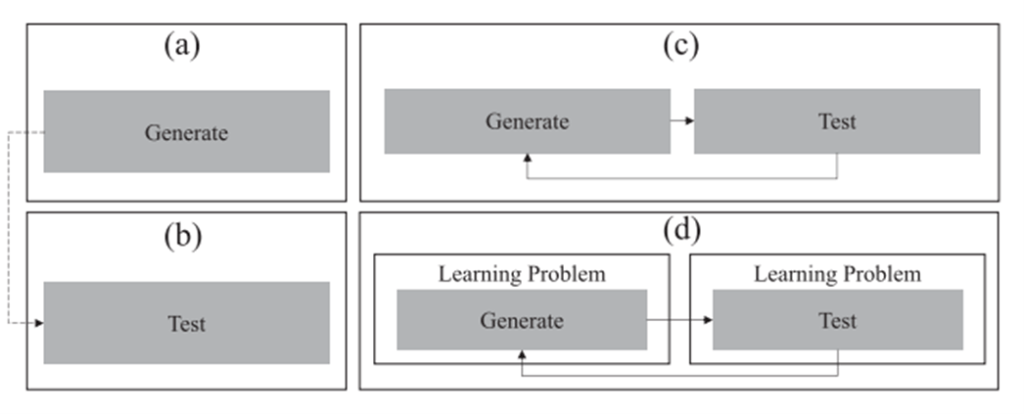
Architectural alternatives for ML-based CCS.
In the context of Machine Learning (ML)-based Computational Creative Systems (CCS), the testing phase involves learning a model to assess creativity aspects like novelty, surprise, or quality in an artifact. ML-based CCS approaches can either generate and test an entire artifact as a batch task or partition the generation and validation into small prediction problems, such as predicting and validating each pixel in an image independently.
To structure the research context of ML as a facilitator for CC, four architectural alternatives for ML-based CCS are proposed. These alternatives include studying the generation and testing phases independently, implementing them as a joint learning problem, or combining them as separate learning problems with feedback. Examples include standalone generation tasks like Google DeepDreamstandalone testing tasks like Wang et al.’s aesthetic classifier, combined learning problems such as Pettee et al.’s variational autoencoder for dance sequences, and two-model systems like generative adversarial networks (GANs).
The article aims to clarify these architectural differences, providing a comprehensive understanding of ML mechanisms in various CCS prototypes and their role in different stages of the creative process.

- Artistic Boundaries: Benefits of Creativity and Innovation through Machine Learning in Contemporary Art
Machine learning algorithms, especially generative models such as Generative Adversarial Networks (GANs) and Variational Autoencoders (VAEs), can be used to create unique and innovative works of art. Artists can use these algorithms to create new images, music, or other types of creative content. In this way, Machine Learning makes people think differently. Artist Mario Klingemann uses GANs to generate unique and mesmerizing artworks. His creations often blend traditional art concepts with the unpredictable and generative nature of machine learning algorithms. The artwork you see below is Klingemann’s work Memories of Passersby I generates portraits in real-time using neural networks. It is a computer system hidden inside of an antique-looking piece of furniture, which looks like a cross between a midcentury modern cabinet and an old-fashioned radio. Klingemann says “the art is not the images, which disappear, but the computer code that creates them. That makes it distinct from other pieces of AI art that have made it to auction–most of which consist of a single unchanging image generated by algorithm.”
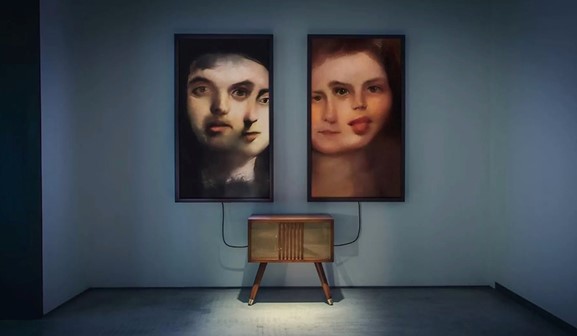
“Mario Klingemann, Memories of Passersby I, 2018 © Courtesy of Onkaos”
Generative Machine learning can support divergent thinking by establishing relationships between distant concepts and generating ideas drawn from them. Machine learning can be integrated into creative software tools, providing artists with intelligent assistance. This includes features like automated image editing, style transfer, and suggestions for creative elements, helping artists experiment and refine their work. For example, adobe’s creative software, such as Photoshop, integrates machine learning features. The “Content-Aware Fill” tool, for instance, uses machine learning algorithms to intelligently fill in or remove elements from images, providing artists with a powerful and time-saving editing tool.
Artists can use machine learning to create interactive installations that respond to the audience’s behavior or input. This can lead to dynamic and engaging art experiences that evolve in real-time based on the viewer’s interactions. For example, the “Rain Room” by Random International is an interactive art installation that uses sensors and machine learning to detect the presence of visitors. The system controls the rain falling in the room, allowing visitors to move through the space without getting wet, creating a dynamic and immersive experience.
Machine learning can help artists interpret and visualize complex datasets in innovative ways. This is particularly relevant in fields such as data art and information aesthetics, where artists transform data into visual representations to convey meaning and provoke thought. Artist Jer Thorp’s “NYT Research & Development Lab” project involved using machine learning algorithms to analyze and visualize large datasets, turning complex information into interactive and visually striking representations, aiding in better understanding and interpretation.
Collaboration between artists and machine learning systems can lead to the development of novel and unexpected creative outcomes. Artists may use machine learning to explore new ideas, styles, or techniques, enriching their creative process. For example, when I transferred a simple sketch, I had drawn to Midjournal and wrote “futuristic heel shoes design “as text, the result was as follows, and it allowed me to get many creative ideas during my design process, and the high variety also allowed me to get different ideas that I had never thought of before.

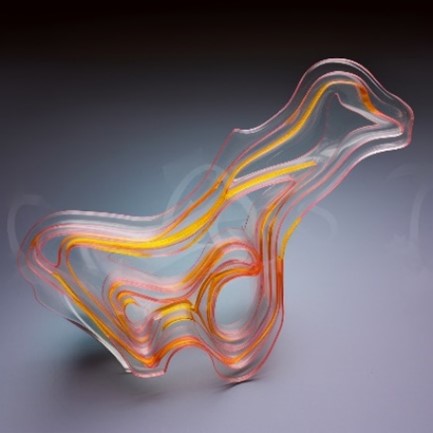

First one what I drew in a short time of 10 minutes.
Second one is my favorite drawing which midjourney showed me.
Third one is the model I made it.
Machine learning can automate repetitive and time-consuming tasks, allowing artists to focus more on the conceptual and creative aspects of their work. This can contribute to increased efficiency and productivity in the art-making process. A common task in digital art is the removal of backgrounds from images, a process that can be time-consuming. Machine learning tools like Adobe’s Content-Aware Fill or tools integrated into graphic design software can automate this process, allowing artists to quickly and efficiently isolate subjects from backgrounds, saving time for more creative endeavors.
Machine learning algorithms can analyze user preferences and behaviors, enabling the creation of personalized art experiences. This could manifest in personalized recommendations, dynamically generated art, or immersive installations tailored to individual preferences. The AI-driven art platform Prisma allows users to transform their photos into artworks inspired by famous artists’ styles. The app uses machine learning algorithms to analyze user preferences and apply artistic filters that suit individual tastes. Users can thus experience personalized transformations of their photos based on their artistic preferences.
Some artists are using machine learning as a medium itself, exploring the creative possibilities inherent in algorithmic processes. This involves manipulating and adapting algorithms to produce unique and aesthetically pleasing results. The artist Anna Ridler has explored the intersection of art and algorithms in projects like “Mosaic Virus” and “Fall of the House of Usher.” In “Mosaic Virus,” she uses machine learning to generate unique variations of tulip images, exploring the concept of tulipomania. Ridler’s work highlights the artistic potential of algorithmic manipulation and the reinterpretation of traditional themes using machine learning.
- Conclusion
In conclusion, this essay has undertaken a comprehensive exploration of the enduring impact of Austrian art historian Alois Riegl and his influential concept of “Kunstwollen” or the will to art. Riegl’s theories, emphasizing the interconnectedness of art and culture, continue to shape the methodologies of contemporary art historians, providing a foundational understanding of artistic intent within cultural and historical contexts.
The narrative seamlessly transitions into the contemporary realm, delving into the intricate interplay between Riegl’s theories and the advent of artificial intelligence (AI) and advanced technology. The essay critically evaluates whether AI, with its technological prowess, can be recognized as the contemporary will of art, considering its ability to replicate artistic styles but questioning its genuine creativity and nuanced understanding of cultural context.
The exploration extends further to machine learning, outlining its applications in creative domains, especially in generative models like GANs and VAEs. The collaborative synergy between artists and machine learning systems, the automation of tasks in the artistic process, and the potential for personalized art experiences highlight the transformative influence of machine learning in the contemporary art landscape.
The discourse progresses to discuss architectural alternatives within ML-based Computational Creative Systems, elucidating the diverse approaches to the generation and evaluation of creative artifacts. The proposed alternatives provide insights into the evolving role of machine learning in fostering creativity and innovation within the realm of art.
Furthermore, the essay examines the benefits of creativity and innovation through machine learning in contemporary art. Artists, utilizing generative machine learning models, can create unique and innovative works, fostering divergent thinking and providing intelligent assistance in the creative process. The integration of machine learning in creative software tools, the development of interactive installations, and the visualization of complex datasets demonstrate the wide-ranging possibilities and contributions of machine learning to the art-making process.
In conclusion, the essay navigates the intricate intersections of art, artificial intelligence, and the evolving concept of artistic will. It emphasizes the symbiotic relationship between historical context and cutting-edge technology, providing a nuanced understanding of how these elements shape the contemporary artistic landscape. As the art world continues to evolve, the ongoing dialogue between tradition and innovation, history, and technology, remains central to understanding the dynamic nature of artistic expression in the modern era.
8 References
[1] Hertzmann Aaron. 2020. Computers do not make art, people do. Communications of the ACM 63, 5 (2020), 45–48.
[2] Riedl, Mark O. (2014). The Lovelace 2.0 test of artificial creativity and intelligence. arXiv Preprint arXiv:1410.6142.
[3] Alpaydin, Ethem (2009), Introduction to Machine Learning, MIT Press, Cambridge (MA).
[4] Moruzzi, Caterina (2018), «Creative AI: Music Composition Programs as an Extension of the Composer’s Mind», in Müller, Vincent C. (ed.), Philosophy and Theory of Artificial Intelligence 2017, Springer, Berlin, DOI: 10.1007/978-3-319-96448-5_8.
[5] Dartnall, Terry (ed.) (1994), «Artificial Intelligence and Creativity», in Studies in Cognitive Systems, vol. 17.
[6] Jiang, Mingming, Thagard, Paul (2014), «Creative Cognition in Social Innovation», in Creativity Research Journal, vol. 26, n. 4, pp. 375-388.
[7] Le, Nam (2019), «Evolving Self-taught Neural Networks: The Baldwin Effect and the Emergence of Intelligence», arXiv:1906.08854v1.
[8] Thagard, Paul (1990), «Philosophy and Machine Learning», in Canadian Journal of Philosophy, vol. 20, pp. 261-76.
[9] Castellano, Federico (2018), «What can Philosophy Teach Machine Learning? », in Medium, 7/12/2018, from https://towardsdatascience.com/what-can-philosophy-teachmachine-learning-4ff091d43de6.
[10] Edmonds, Ernest (1994), «Introduction: Computer-based Systems that Support Creativity» in Dartnall (1994), pp. 327-334.
[11] S. Colton and G. A. Wiggins, “Computational creativity: The final frontier?”, Proc. 20th Eur. Conf. Artif. Intell., pp. 21-26, 2012.

